

Can Excel convert currency? Using the EUROTOOL.XLAM Excel Add-in - maymanded
Excel can convert currency given the right tools. While there are dozens of currency conversion websites or other conversion tools that you put up use online operating theater leverage, they work unexceeded for looking up one currency transaction at a time. If, along the other hand, you need a table of multiple transactions or currencies for multiple countries, you can use Excel to accomplish this chore with the Excel Add-In called EUROTOOL.XLAM.
Line that to preserve with vogue fluctuations, your usage with Stand out should include an Cyberspace connection, so you tail receive updates. We've provided a worksheet for you to practice using the currentness conversion techniques in this story:
Use this worksheet to rehearse doing currentness conversions in Excel. JD Sartain
Instal / Encumbrance the Euro Currency tool
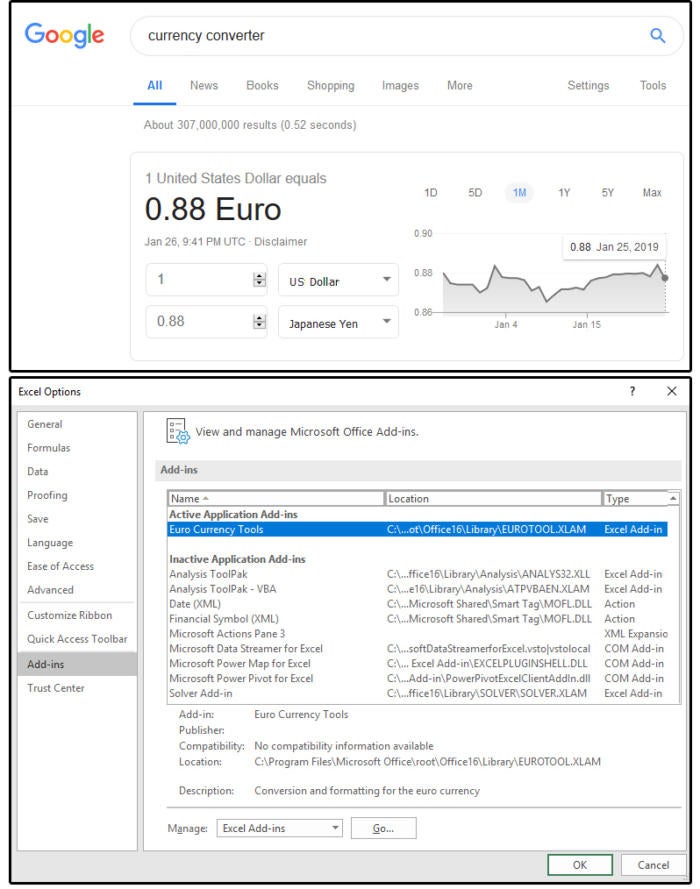
If you try to use this function and invite an error, you must first install and load this tool.
1. Select File > Options > Add-Ins
2. Curlicue down to the Circuit board called EUROTOOL.XLAM
3. Click to select information technology, then click OK.
 JD Sartain / IDG Worldwide
 01 An online currency converter throne take you only so far, which is wherefore you power want to install Excel's Euro Currency tool.
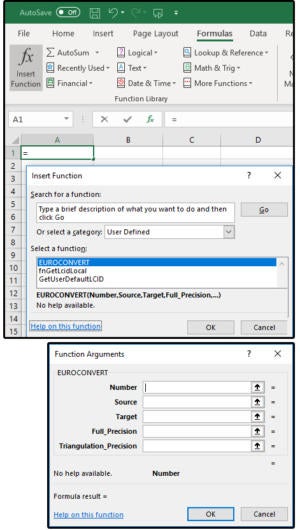
4. The syntax for this command is: =EUROCONVERT(number,seed,target,full_precision,triangulation_precision).
5. To place, select Formulas (tab) > Insert Function (button in the Function Library group). In the Sneak in Office dialog window, click the down arrow beside the Or select a category field box, then scroll down and select EUROCONVERT.
6. Click OK and the Function Arguments dialog opens.
7. All of the arguments shown here (figure,source,target,good precision,triangulation precision) therein dominate are required and defined as follows:
a. Number: This is the currency evaluate you want to change (can also make up a cell plow for the location of this economic value).
b. Source: This is the three-letter ISO write in code for the source currency; e.g., Spain equals ESP. This can also be a cell address for the location of this code.
c. Target: This is the three-missive ISO code for the target currency; e.g., France equals FRF. This can besides be a jail cell call for the location of this code.
d. Full Precision: Either TRUE or FALSE. True means all significant digits (from the figuring) are displayed. False means the result is shown with the currency-specific rounding error rules practical; that is, the rules that determine how the results are rounded—up or down to the nearest cent; to the nearest unit or sub-unit; or to a multiple or fraction of the unit or sub-whole. Note that for a result that is exactly halfway, the tote up is ear-like upwardly. False is the default on if the Full Precision literary argument is omitted. Put differently, if you don't enter anything (true or false), Excel assumes the respond is FALSE.
e. Triangular Precision: Surpass computer storage 15 significant digits of precision. In around situations, this can be a problem. For this literary argument, you can set the number of digits capable or greater than 3. Confused? See examples in screenshot images.
8. Enter the appropriate arguments, so click Alright.
 JD Sartain / IDG Worldwide
 02 Select EUROCONVERT and enter appropriate arguments.
NOTE: The EUROCONVERT function in Excel does not change Joined States dollars, just the following countries to and from one another: Euros, Austria, Belgium, Finland, France, Germany, Greece, Ireland, Italia, Grand Duchy of Luxembourg, Netherlands, Portugal, and Espana.
I have no idea wherefore Microsoft would create a function that does non include the United States! However, there is a workaround.
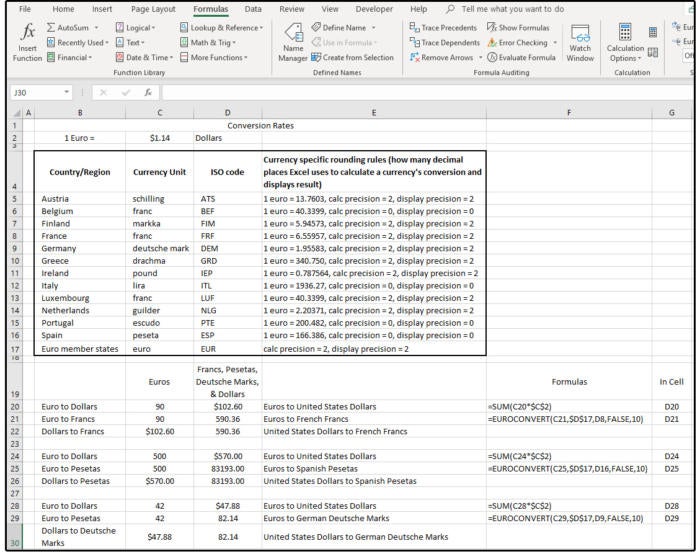
1. Replicate or download the EUROCONVERT table from the Internet and library paste it into your spreadsheet, or download this spreadsheet and use ours.
2. Because the EUROCONVERT mathematical function South Korean won't convert dollars, the make-around is to select a cell at the top of the spreadsheet (e.g., C2) and enter the current transition rate for combined Euro that equals one clam (that is, $1.14).
3. Next, use the EUROCONVERT function to convert 90 Euros to dollars ($102.60). To act that, enter this formula in cell D20: =Meat(C20*$C$2). C2 is the cell that contains the buck sum for one Euro (that is, $1.14). Date spreadsheet surgery figure 03.
4. In D21, enter this formula: =EUROCONVERT(C21,$D$17,D8,FALSE,10) where C21 is the emplacemen of the number of Euros you neediness converted; $D$17 is the location of the Euro code; D8 is the location of the code for French Francs; FALSE is the Full Precision encrypt for specific rounding rules applied; and 10 is Many-sided Precision (a safe figure for the significant digits of precision).
5. In summary, 90 Euros equals $102.60 dollars, and 90 Euros equals 590.36 Francs; so $102.60 equals 590.36 Francs.
 JD Sartain / IDG Cosmopolitan
 03 EUROCONVERT table plus examples with formulas

Source: https://www.pcworld.com/article/403244/can-excel-convert-currency-using-the-eurotoolxlam-excel-add-in.html
Posted by: maymanded.blogspot.com
0 Response to "Can Excel convert currency? Using the EUROTOOL.XLAM Excel Add-in - maymanded"
Post a Comment